
Built around 14 CFR 145.163, AC 145-10, and AS9110
How the program gets approved, how the manual is produced and submitted, and where each element of AC 145-10 and each AS9110 clause lives in True North. Use it to prepare for your principal maintenance inspector's review or a registrar audit.
Not sure where you stand? Take the six minute audit readiness check
How approval of the program works
A Part 145 repair station must have an employee training program approved by the FAA (14 CFR 145.163(a)), and revisions are submitted to the responsible Flight Standards office before use. The FAA approves your program, not the software. True North keeps the program, the records, and the manual in step so the review goes quickly. The program type you choose sets who approves the program and how the manual words it.
Part 145 repair station
The FAA approves the program. The manual carries an FAA approval block: record the approval letter reference when it arrives, and records cite that revision.
Part 135 operator maintenance
The FAA accepts the program as part of the manual required by 14 CFR 135.427, for an operator that maintains its own aircraft. Revisions go to the responsible Flight Standards office before use.
Part 91 flight department (IS-BAO)
A company program approved by management, following IS-BAO. The FAA does not approve it, and the manual says so.
Maintenance shop without an air agency certificate
A company program approved by management. The shop holds no repair station certificate, so the FAA does not approve the program, and the manual says so. Mechanics work under their own certificates (14 CFR Part 65).
AS9100 or AS9110 organization
A company program approved by management that shows competence under clause 7.2 and awareness under clause 7.3. It is not an FAA approved program, and the manual says so.
What True North is not
True North is not FAA approved, FAA certified, or endorsed by the FAA, and the FAA does not approve training software. The FAA approves your repair station's training program under 14 CFR 145.163; True North produces the manual you submit and keeps the records the approved program requires. True North is designed to align with AS9110 clauses. Using it does not make your organization AS9110 certified: only an accredited registrar certifies an organization, after auditing how you work.
How the manual is generated and submitted
The Training Program Manual (TN-TPM) is built from the live program in the structure AC 145-10 describes: responsibilities, needs assessment, course definitions for every item, revisions, distribution, operator training, and interim and contract employees.
Fill in the station details
The certificate number, the responsible Flight Standards office, and controlled copy holders, on the Program and manual tab.
Check hire dates and initial windows
Each employee's hire or assignment date on their training record, and each initial item's window on the Training items tab.
Review every course definition
Edit objectives, outline, hours, methods, sources, and evaluation to match how the station trains.
Build the instructor register
Then turn on the option that accepts training approvals only from people in the register.
Start a revision and freeze it
Review the draft manual, freeze it as a PDF with a SHA-256 fingerprint, and send it to the responsible Flight Standards office.
Record the approval
Enter the approval letter when it arrives. The manual is stamped and every record from then on cites the approved revision.
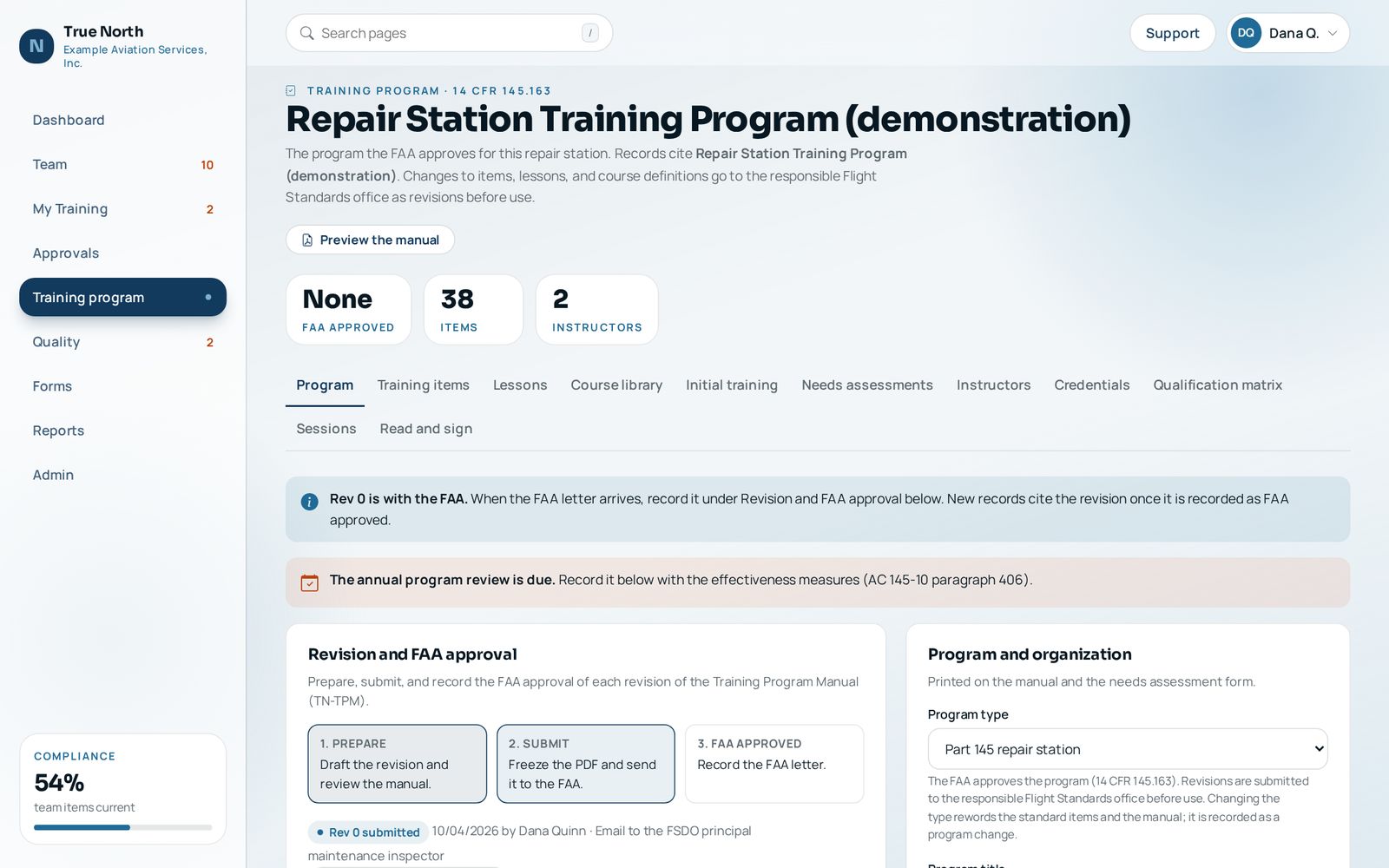
Sample output: Training Program Manual (TN-TPM) (PDF, watermarked)
AC 145-10 crosswalk
Each element of FAA Advisory Circular 145-10, Repair Station Training Program, and 14 CFR 145.163, with where it lives in True North. The repair station remains responsible for the content and adequacy of its program (AC 145-10 paragraph 404(c)).
| AC 145-10 | What the FAA looks for | Where it lives in True North |
|---|---|---|
| 145.163(a), 201 | An FAA approved program with initial and recurrent training | Training Program Manual (TN-TPM) generated from the live program; Program and manual tab records submission and FAA approval |
| 145.163(b), 203a | Each employee assigned to maintenance, preventive maintenance, alteration, or inspection is capable of the assigned task | Items required by position, needs assessments, evaluations, and the qualification matrix |
| 145.163(c), 407(c) | Training records kept at least 2 years | Records kept for employment plus at least 2 years; removing an employee's profile keeps the binder files and record rows |
| 145.163(d), 145.209(e), 202 | Revisions submitted to the responsible Flight Standards office | Revision workflow: draft, frozen PDF with SHA-256, submitted, FAA approval letter recorded; records cite the approved revision |
| 203f | Responsibility and authority, written procedures, revision system, distribution | TN-TPM sections 1 (responsibilities), 7 (revisions), revision record, and distribution statement |
| 301(b) | Indoctrination: regulations, manuals and QC, hazmat, OSHA, EPA, human factors, computer systems, facility security | Items 01 to 13 and 37; the Indoctrination lesson covers computer systems, facility security, environmental, and hazmat shipping awareness; item 37 Information Security Awareness covers phishing, passwords and two-step verification, customer and export-controlled data, and reporting |
| 301b(4) | Human factors elements | Item 03 lesson: error, Dirty Dozen, fatigue, stress, situational awareness, turnover, reporting |
| 302 | Initial training for new employees | Hire or assignment date on each training record; each initial item has a window in days (for example indoctrination 5, regulations 30); Initial training tab tracks progress and overdue items; employees work under supervision and New Hire accounts stay restricted until initial training is complete; TN-TPM section 2.3 |
| 303 to 305 | Recurrent, specialized, and remedial training | Areas of study (Initial, Recurrent, Safety, Specialized, Inspection and Authorization, Aircraft Type); remedial training and lesson reassignment |
| 400(a)(1), 401(a) | Repair station needs assessment | Annual program review with effectiveness measures; TN-TPM section 2.1 |
| 401(b) | Individual needs assessment: objective methods, documented, qualified assessor, monitored | Needs assessments tab and form TN-NA-01: trigger, methods, prior credit, findings, required and credited items, restrictions, employee acknowledgement; filed in binder Tab 2 |
| 401(a)(2) | Return to tasks after an extended period | Needs assessment trigger and a list of people with no training in 12 months |
| 402(b) | Course definition: prerequisites, materials, methods, sources, instructors, outline, time, evaluation, forms | Course definition for every item, printed in TN-TPM section 3.3 |
| 403 | Training methods (classroom, OJT using approved data, CBT, distance, embedded, self study) | Online lessons (CBT), classroom with roster TN-TAR-01, OJT records TN-OJT-02, practical evaluations |
| 404 | Training sources | Source on each course definition; government video sources credited in lessons |
| 405 | Qualifying instructors | Instructor and evaluator register with scope, basis, approval, and expiration; optional enforcement on approvals |
| 406 | Measuring effectiveness | Post test results, first-attempt pass rates, lockouts, question review; annual program review record |
| 407(b) | Record content: name and position, requirements, certificates, authorizations, course title, objective, date, test results, hours, location, instructor, employee signature | Training record, binder tabs 1 to 6, transcript; each completion stores hours, method, location, approver, program revision, and the employee's electronic acknowledgement. Certificates and authorizations are entered in the credential register with numbers, ratings, expirations, IA renewal activity (14 CFR 65.93), and scanned copies |
| 408 | Interface with work assignment | Qualification matrix (CSV export) and My Training status; items overdue, revoked, or awaiting OJT, and initial items past their window, are not current |
| 409 | Stations outside the United States | Not specific to the software; the station's needs assessment covers English language ability |
| Appendix 1, Sec 8 | Work for Part 121, 125, 129, 135 operators | TN-TPM section 8 states how operator training requirements are brought in; the station adds each operator's items to the catalog when it takes on that work |
| Appendix 1, Sec 9 | Interim and contract employees | TN-TPM section 9; a needs assessment is recorded before the person is assigned work, and contract staff are tracked as employees |
| 403(b)(1) | Classroom training delivered to a group | Training sessions for items whose course definition lists classroom instruction: schedule, enroll with a waitlist, phone attendance, roster TN-TAR-01 in binder Tab 6; recording sends each attendee's completion, evaluated as the course definition says, for approval |
| 405 | The person teaching is qualified | A session instructor must hold an active, unexpired instructor register entry whose scope covers the item (all items for a library course with no item); admin access is not a qualification. Checked when the session is scheduled and when it is recorded. The instructor approves each attendee's record unless the instructor's role cannot approve that attendee; then the training manager or another qualified approver for the attendee's shop does (never the system administrator account), and the record still names the instructor |
| 407(b)(7) | Course title, objective, date, test results, hours, location, instructor, employee signature (classroom sessions) | Each session request carries the course title, the course definition's evaluation, date, written score, practical result or lesson post test, hours, location, and instructor name and employee ID; the employee's signature is their roster signature on the day or their acknowledgement afterwards, and the approval waits for one of them |
| 203f(8), 203f(9) | Distribution of the manual and its revisions | Read and sign: each approved TN-TPM revision is issued as a manual revision notice to every employee, who acknowledges it; the register TN-RS-01 shows who has and has not. Assignments are recorded at issue and as people join or change role or shop while the document is current; registers of superseded revisions are built from them (AS9110 7.5.3.2 c), d)) |
| 145.207(c); AS9110 7.3, 7.5.3 | The current manual is accessible to the people who use it, and they know the changes that apply to them | Read and sign: documents issued by role and shop with a due date, reminders, overdue banner, nav badge, digest line; a new revision supersedes the old and is acknowledged again |
| 301(b)(2) | Changes to company manuals and procedures reach employees between indoctrination courses | Bulletins, procedures, and policies issued through read and sign with each acknowledgement kept in the same system as the training records; this is awareness (AS9110 7.3), not indoctrination training, which stays on items 01 to 13 |
| 406 | Program effectiveness measured and reviewed | Reports page: status by shop and category, trends, first-attempt pass rate, retakes, days to approval, returned requests, initial windows met; every number lists its source query; management review pack and recorded reviews with stored snapshots; each review records the top management present inside its record digest; month end counts are written once and never changed; the second measure of 406(a), capability in the actual work, comes from the station's inspection findings and corrective actions linked to training items |
| 302 | Initial training windows met for new hires | Reports page "Initial training of new hires": met, completed late, on track, past a window |
| 145.163(c), 407(c) (record protection) | Training records kept and retrievable for the retention period | Daily backups with a SHA-256 manifest, each verified when written (14 on the server, off-site copy of at least 30 days per the operations guide), monthly verification of an off-site archive, yearly restore drill; the system administrator's Operations page shows the last backup, whether it verified, and database integrity; retention statement in the operations guide |
These rows are written for the Part 145 program type. For Part 135 operator maintenance, the program type rewords the items and the manual, and the FAA accepts the program as part of the manual instead of approving it. For a Part 91 flight department, a maintenance shop without an air agency certificate, or an AS9100 or AS9110 organization, the program follows the AC 145-10 structure as best practice and management approves it; there is no FAA approval.
Electronic records and signatures
Personal, authenticated accounts
Every record is created through a person's own account. Accounts start with a temporary password, two-step verification can be required for supervisors and managers or for everyone, failed sign-ins lock the account, and sign-ins and account changes are logged.
The approver is the signer of record
A completion logged in the system is issued only when an authorized approver approves it. Each OJT event is approved by the instructor who signed it, and a new hire cannot log the qualification for an OJT item until its required OJT events are approved.
Signatures only for people who acted
"/s/ Name, Electronic signature" prints for the approver, dated the day of approval, and for the employee, dated the day they submitted or acknowledged. Imported or transcribed records print names without a signature and name who entered them.
An audit log the application never edits
Every change is written to an audit log that the application never edits or deletes with a SHA-256 digest of the affected records, so each change can be traced to who made it and when (14 CFR 145.12, AS9110 7.5).
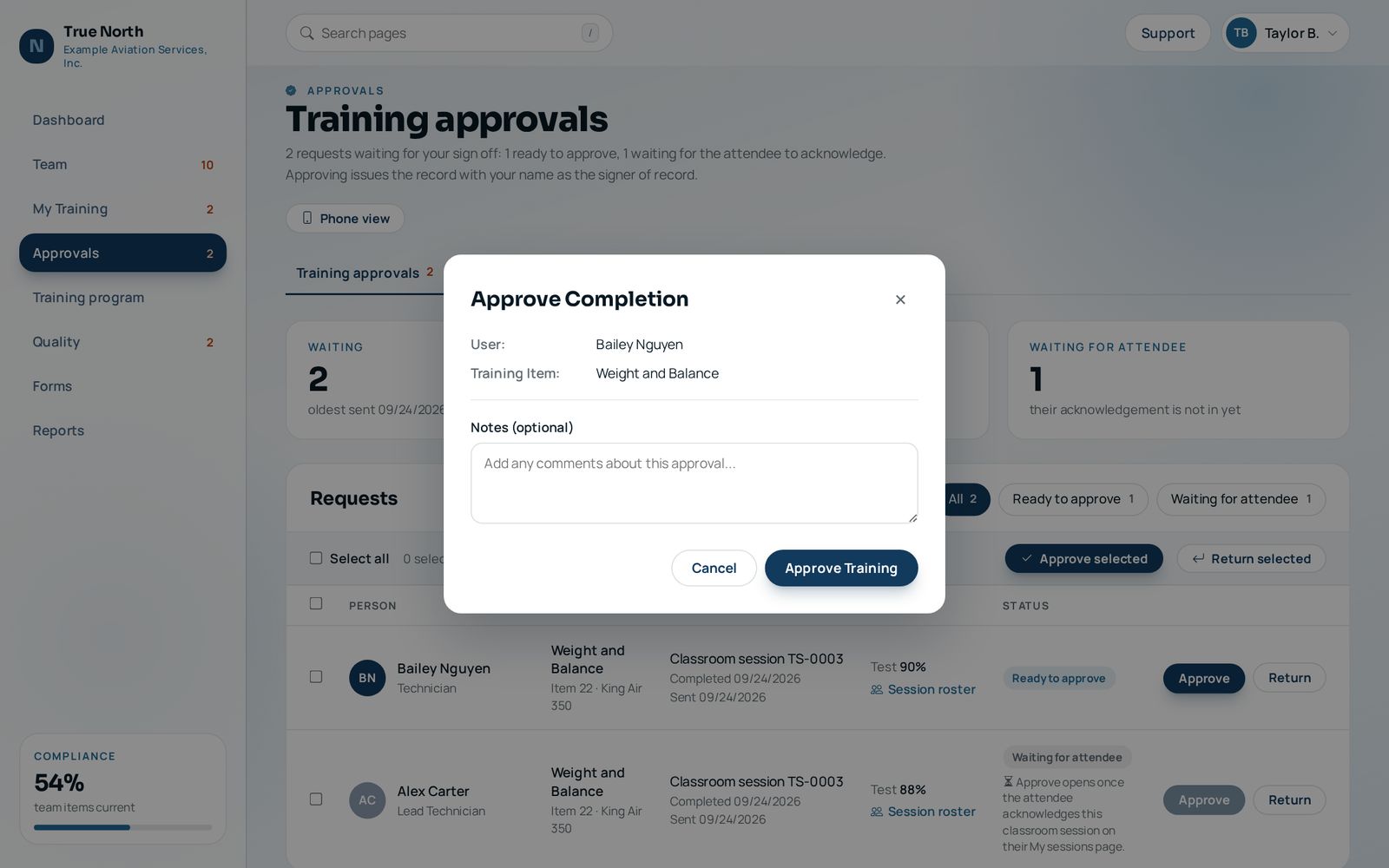
Sample output: Personnel training records (PDF, watermarked)
AS9110 clause map
Where True North's features align with the clauses a registrar will sample. Alignment is not certification: your organization is certified by its registrar, and the software is not. Confirm citations against the revision of AS9110 your organization is registered to.
| Clause | Title | How True North supports it |
|---|---|---|
| 6.1 | Actions to address risks and opportunities | Safety reports rated on a five by five risk matrix, a hazard log with assigned actions, and indicators in the management review pack. |
| 7.1.5 | Monitoring and measuring resources | A training item and lesson for calibrated tools and test equipment, required by role. |
| 7.2 | Competence | Items required by position and aircraft type, needs assessments, evaluations, OJT, the instructor register, credentials, and the qualification matrix. |
| 7.3 | Awareness | Indoctrination and human factors lessons, read and sign documents when a procedure changes, and safety reports that close the loop back to the reporter. |
| 7.5 | Documented information | Binder PDFs, controlled documents with revision history, records that cite the program revision, and an audit log the application never edits or deletes with a SHA-256 digest. |
| 8.5.1 | Control of production and service provision | Completions issued only through an authenticated approver, and a current or not current answer for work assignment through the matrix and the API. |
| 9.1 | Monitoring, measurement, analysis and evaluation | Post test results, first attempt pass rates, initial training on time, the AS9110 dashboard, and quality trends. |
| 9.2 | Internal audit | Internal audits with findings that open corrective action requests, and an internal audit lesson for auditors. |
| 9.3 | Management review | The management review pack and the annual program review record. |
| 10.2 | Nonconformity and corrective action | Corrective action requests from audits and safety reports, linked to the training item that addresses the cause, with a CSV of candidates for your QMS. |
This page describes what the software provides. It is not a certification or an FAA finding: compliance depends on how your organization configures, hosts, and runs the system.
Preparing for a PMI review or an audit?
We will walk through the crosswalk with your program type and show where each record comes from.